
Astroturf Pitch Floodlighting: What It Actually Takes to Light a Community Pitch
October 13, 2026
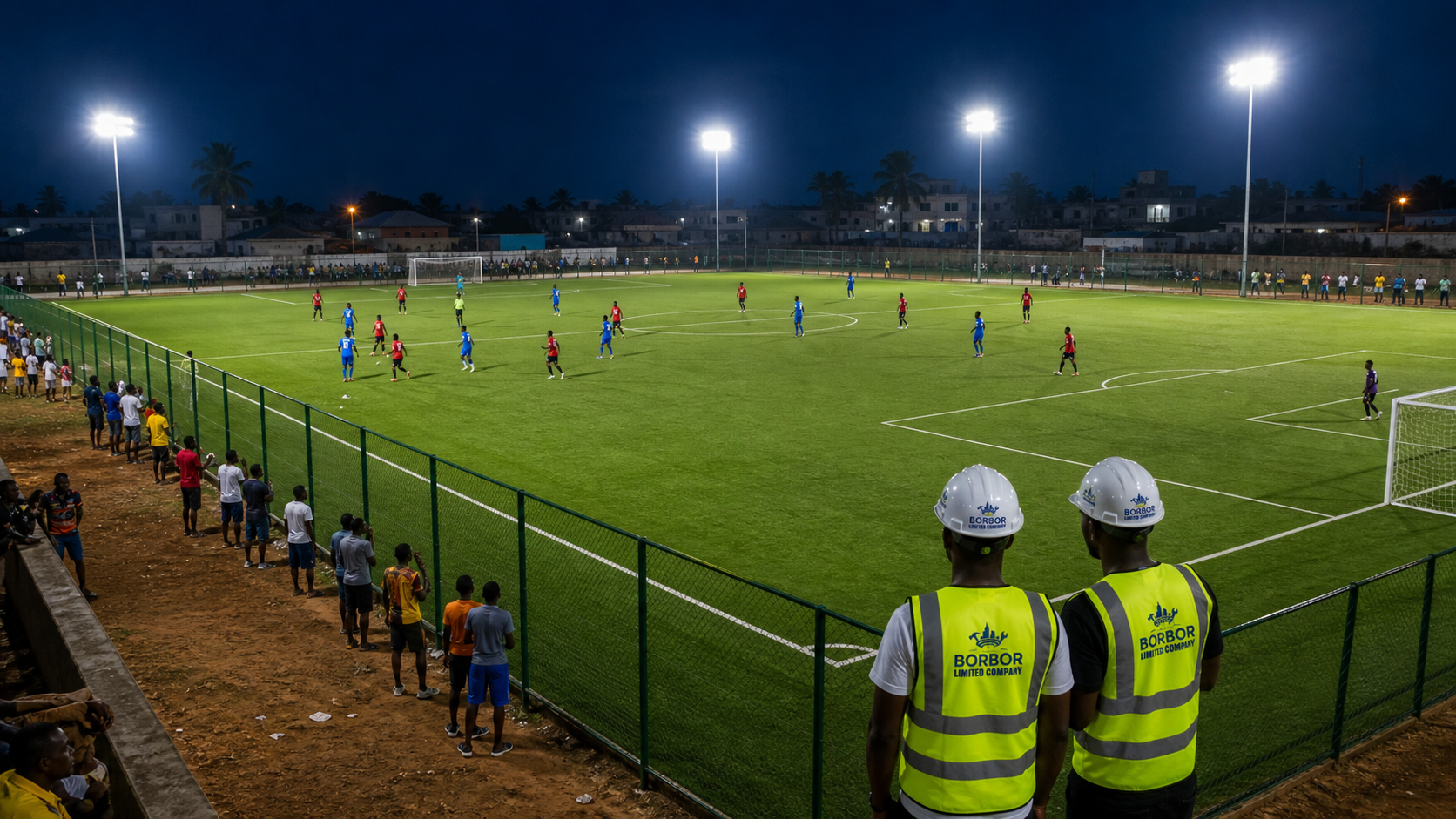
Astroturf Pitch Floodlighting: What It Actually Takes to Light a Community Pitch
If you are building or upgrading a community astroturf pitch in Accra, floodlighting will come up early. It has to. A pitch that goes dark at 6pm loses most of its usable hours, and in a city where people play after work, after school, and into the evening, that is a serious loss. Good astroturf pitch floodlighting is not just about brightness. It is about even coverage, stable power, and making decisions in the right order. Here is what that actually involves.
Why Floodlighting Needs to Be Planned Before the Pitch Is Built
This is the mistake most people make. They finish the pitch, lay the turf, and then think about lights. By that point, the decisions have already been made for them, badly.
Pole placement is the clearest example. To light a full pitch evenly, poles need to sit at specific positions around the perimeter. Those positions affect where you run conduit underground, where you pour concrete footings, and how you manage drainage around the base of each pole. If the pitch is already built, you are now digging through finished work. That costs more and often produces a worse result.
The same applies to power. Running electrical supply to a pitch requires trenching for cable. If that trenching is done while the site is open and before the turf is down, it is straightforward. If it is done after, you are cutting through a finished surface.
The rule is simple: lighting is a structural decision, not a finishing touch. Plan it at the design stage.
Power Supply and Backup: The Part People Underestimate
Accra's power supply is real and it is not always reliable. Any community pitch that depends on ECG alone will face evenings where the lights simply do not come on. For a pitch that generates income from bookings, that is lost revenue and frustrated customers. For a pitch that serves a community, it is a broken promise.
The honest answer is that most serious pitch projects in Ghana plan for backup power from the start. What form that takes, whether generator, solar-plus-battery, or a hybrid setup, depends on several factors specific to your site:
- How many hours per day will the pitch run under lights? A pitch with heavy evening bookings needs more robust backup than one used occasionally.
- What is the available space for equipment? Solar panels need roof or ground space. Generators need a secure housing with ventilation.
- What is the load? The number of poles, the wattage of each fitting, and any other electrical demand on the site all affect what backup capacity you actually need.
These are engineering questions with specific answers, not guesses. Getting them right at the design stage means you size the system correctly the first time, rather than paying to upgrade it later.
Astroturf Pitch Floodlighting: Pole Placement and Even Coverage
The goal of good floodlighting is simple to state: every part of the playing surface should be bright enough to play comfortably, and no player should be looking directly into a glare source.
In practice, this means the angle, height, and spacing of poles all matter. Poles that are too short throw light at a shallow angle and create harsh shadows. Poles that are poorly spaced leave dark patches in the middle of the pitch or in the corners. Fittings that are aimed incorrectly blind players looking toward the goal.
The factors that determine the right setup for your specific pitch include:
- Pitch dimensions. A full-size pitch and a five-a-side pitch need completely different approaches.
- Surrounding obstructions. Trees, buildings, and walls affect where poles can go and how light behaves once it is in the air.
- Neighbour impact. In residential areas of Accra, light spill onto neighbouring properties is a real concern. Good design keeps light on the pitch and out of people's homes.
- Fitting type. LED fittings have largely replaced older metal halide options because they reach full brightness immediately, use less power, and last significantly longer. But not all LED fittings are equal: beam angle and IP rating for outdoor use both matter.
A lighting layout should be modelled before any poles are ordered. This is standard practice and it removes guesswork from the process.
What Drives the Cost of Pitch Floodlighting
We will not give you a number here, because the honest answer is that the cost of astroturf pitch floodlighting depends entirely on your site. What we can tell you is what moves that number up or down:
Pitch size is the biggest driver. More surface area means more poles, more fittings, and more cable.
Power infrastructure is often the hidden cost. If your site already has adequate electrical supply close to the pitch, that is straightforward. If you are starting from scratch or need significant backup capacity, that adds to the scope.
Pole specification matters. Taller poles with higher-wattage fittings cost more upfront but often produce better coverage and fewer poles overall, which can reduce installation cost and long-term maintenance.
Integration with the build. As already noted, lighting planned and installed during construction is almost always cheaper than lighting retrofitted to a finished pitch.
The only way to get a real figure is to have someone walk the site, understand the pitch dimensions, check the power situation, and model the lighting layout. That is what a proper site assessment gives you.
Talk to Borbor Before You Commit to a Layout
At Borbor Limited, we build pitches and community facilities with the full picture in mind from day one: structure, drainage, surface, and lighting together, not in sequence. We research the site before we recommend anything, and we will tell you plainly what your project needs and why.
If you are planning a community pitch in Accra and want to understand what floodlighting will actually involve for your specific site, get in touch. We offer free site assessments, and we will give you a straight answer, not a sales pitch.