
U-Drains, Culverts, and Retention Basins: Stormwater Drainage Ghana Explained
September 11, 2026
U-Drains, Culverts, and Retention Basins: Stormwater Drainage Ghana Explained
Accra gets serious rain. The major rainy season runs roughly April to July, and a shorter one follows in September and October. When those storms hit, a poorly drained site doesn't just flood. It erodes foundations, undermines roads, and turns a finished compound into a maintenance problem that never goes away. Good stormwater drainage in Ghana starts with understanding three core components: U-drains, culverts, and retention basins. Each one does a different job. Using the wrong one, or sizing it for the wrong rainfall intensity, is where most drainage designs fail.
What a U-Drain Actually Does
A U-drain is an open concrete channel, shaped like the letter U, that collects surface runoff and moves it away from a structure. You see them lining roadsides across Accra, running alongside compound walls, and cutting through markets and estates.
They work well when you need to move water quickly across a relatively flat or gently sloping surface. The key word is move. A U-drain doesn't store water. It directs it somewhere else. That somewhere else needs to be thought through before the drain is ever built.
The sizing of a U-drain matters enormously. A channel that's too narrow backs up during peak flow and spills over. A channel that's too wide is expensive to build and maintain for no benefit. The right size depends on the catchment area, meaning how much land is draining into it, and the rainfall intensity for that specific location.
This is where generic designs fail. Ghana's rainfall isn't uniform. Intensity in parts of Greater Accra differs from intensity in the Volta Region or the Northern Region. Even within Accra, local topography affects how fast water concentrates and flows. A drainage design should be sized against actual local data, not a generic regional standard copied from a textbook.
When You Need a Culvert Instead
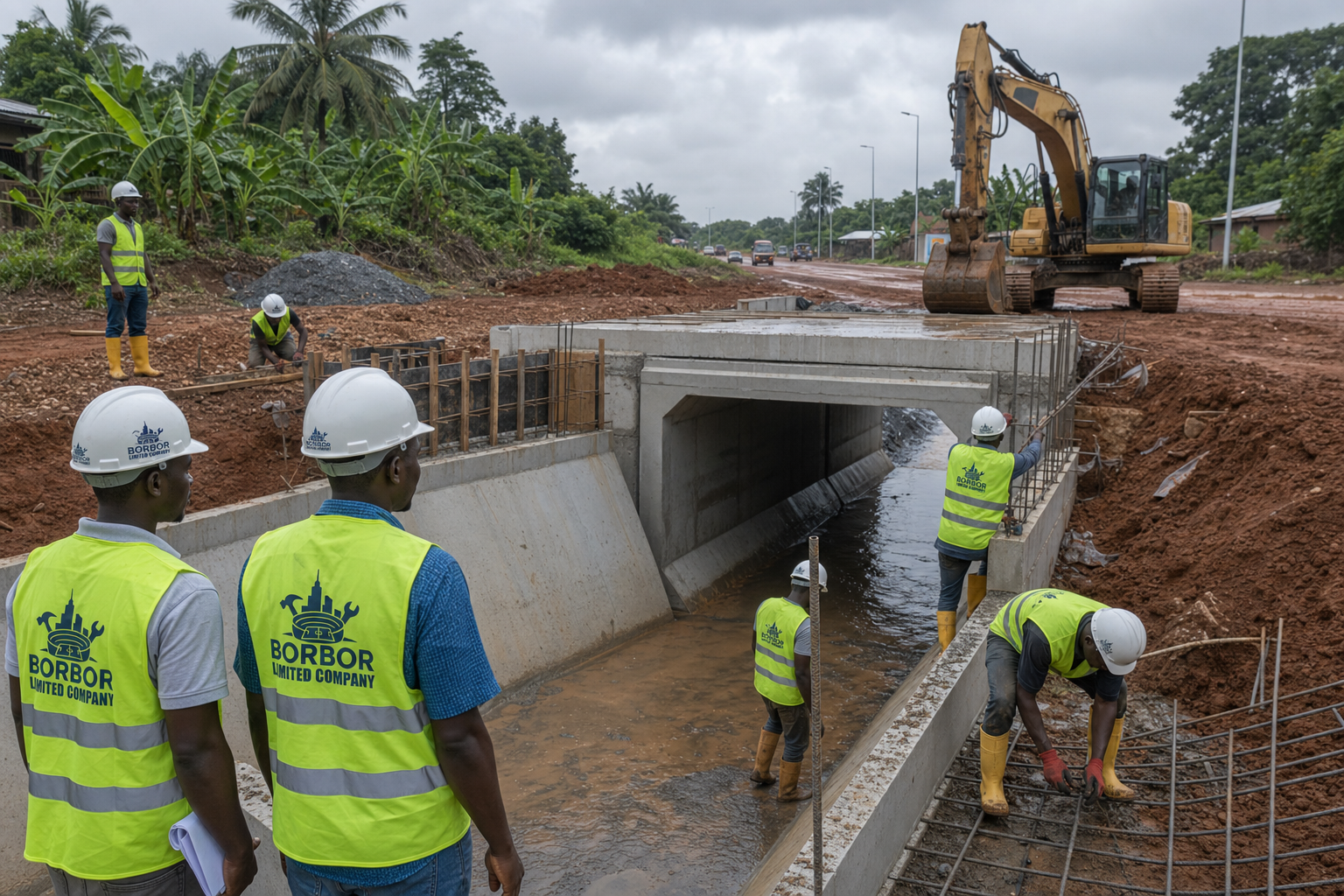
A culvert is a pipe or box structure that carries water under something: a road, a driveway, a path, a building platform. Where a U-drain moves water along the surface, a culvert moves it through an obstruction.
In Accra's peri-urban areas and along newly developed plots, culverts are frequently undersized or skipped entirely. The result is predictable: water backs up on the upstream side, the road or driveway acts as an accidental dam, and eventually something gives way. Either the fill material erodes or the road surface cracks and collapses.
Culvert sizing follows the same logic as U-drain sizing. You need to know the upstream catchment area, the expected peak flow rate, and the slope of the channel. You also need to account for debris. Culverts in Ghana regularly carry leaves, plastic waste, and silt. A culvert sized only for clean water will block up in the first wet season and fail exactly when you need it most. Good design includes a safety margin for partial blockage and a maintenance plan for clearing.
Material choice matters too. Reinforced concrete box culverts handle heavy loads well and are a common choice under vehicle access points. Corrugated metal pipes are faster to install but can corrode in certain soil conditions. The right call depends on your site's soil chemistry, the load above the culvert, and how accessible it will be for maintenance.
Retention Basins: Slowing Water Down Before It Causes Damage
A retention basin, sometimes called a detention basin, is a designed low point that temporarily holds stormwater and releases it slowly. It doesn't move water fast. It holds it.
This is the component most residential and commercial projects in Accra skip, and it's often the most important one on larger plots or sites with significant impervious cover, meaning concrete, roofing, and paving that doesn't absorb rain.
Here's the problem retention basins solve. When you build on a plot, you replace permeable soil with hard surfaces. Rain that used to soak in now runs off immediately, all at once. The peak flow leaving your site increases sharply. If your U-drains and culverts downstream weren't designed for that increased flow, they overflow. Your neighbours flood. The road floods. You may be legally and practically responsible.
A retention basin absorbs that surge. It fills during the storm and drains slowly afterward, releasing water at a rate the downstream drainage can handle. On large sites, this is often a legal requirement. On smaller plots, it may not be mandated but can still be the difference between a drainage system that works and one that fails every June.
The size and shape of a retention basin depends on your site area, the proportion of hard surfaces, the local rainfall intensity, and the capacity of the drainage system you're connecting to. There is no single standard size. Every site is different.
Why Local Rainfall Data Changes Everything
The Ghana Meteorological Agency publishes rainfall records, and engineering design standards exist for the country. But applying those standards correctly means using data that reflects your specific location and return period, meaning how often you expect a storm of a given size to occur.
A drainage system designed for a one-in-five-year storm will be overwhelmed by a one-in-twenty-year event. Whether that matters depends on what's at stake. A residential compound driveway and a hospital access road are not designed to the same standard. The consequences of failure are different, and the design should reflect that.
At Borbor Limited, we assess the actual site conditions, including soil type, slope, existing drainage paths, and proximity to natural watercourses, before recommending any drainage approach. We don't apply a template. We size what the site needs.
Talk to Us Before You Build
If you're planning construction in Accra and haven't had a drainage assessment done, that's the first step. The right drainage design protects your investment, protects your neighbours, and avoids expensive repairs after the first rainy season.
Contact Borbor Limited for a free site assessment. We'll look at your plot, explain what your site actually needs, and give you an honest recommendation: not the most expensive option, the right one.