What Is a Titantrax Running Track in Ghana, and Does Your Facility Need One?
October 30, 2026
What Is a Titantrax Running Track Ghana Facilities Are Installing?
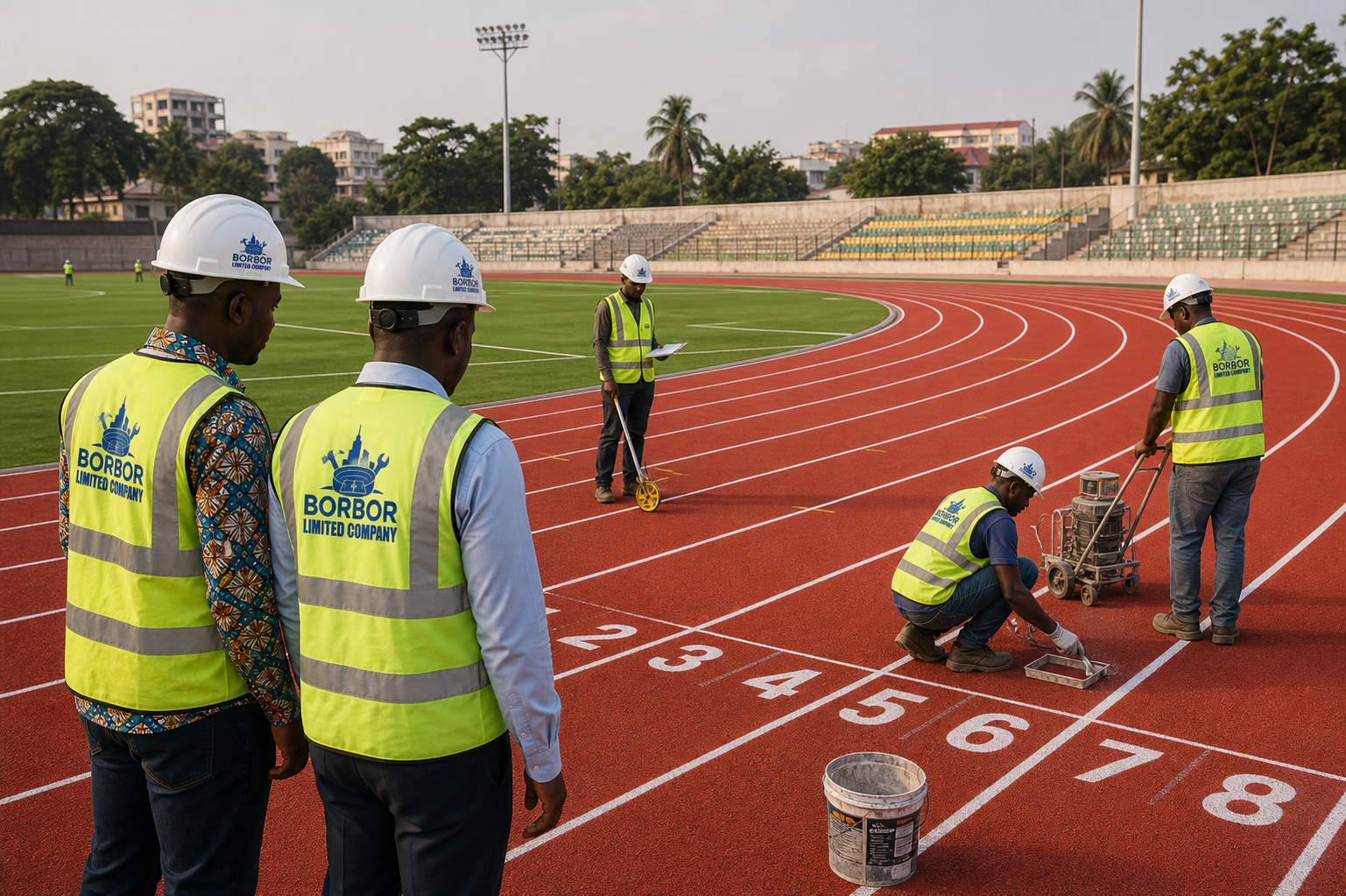
If you have been researching athletic infrastructure for a school, sports complex, or community facility in Accra, you have likely come across the term Titantrax running track. It refers to a prefabricated polyurethane track surface system, a structured, layered running surface engineered for consistent grip, shock absorption, and weather resistance. In Ghana, where facilities face intense UV exposure, heavy seasonal rainfall, and laterite-heavy soils that shift and drain unpredictably, the surface itself is only part of the story. What happens underneath it determines whether the track lasts five years or twenty.
This post explains what a Titantrax track build actually involves, why it shares the same foundational logic as a quality pitch construction, and how to decide whether a track makes sense for your facility right now, or whether the timing is wrong.
The Build Process: Why It Starts Below the Ground
Many facility owners assume a running track is a straightforward overlay: clear the land, compact the surface, lay the material. That assumption leads to cracked tracks, pooling water, and uneven lanes within a few rainy seasons.
A proper Titantrax running track installation follows the same soil-first, drainage-first logic that governs any serious construction in Accra.
Soil assessment comes before any quote. Accra's terrain varies significantly. The soils in Tema differ from those in Kasoa. Laterite content, clay density, and the water table all affect how a base layer will behave under repeated foot impact and seasonal saturation. A track laid on poorly assessed ground will heave, crack, or sink, usually at the curves first, where lateral stress concentrates.
Drainage is engineered, not assumed. Accra's rainy seasons, particularly the major rains between April and July, deliver heavy, concentrated downpours. A track surface that cannot shed water quickly becomes a liability. Standing water degrades the polyurethane bond, creates slip hazards, and accelerates sub-base deterioration. Proper drainage channels, gradients, and sub-base permeability are specified before the surface is ever ordered.
The sub-base is load-bearing infrastructure. Compacted aggregate layers must be graded and tested before the binder course goes down. This is not different in principle from preparing the base for a concrete slab or a football pitch. The surface material is the finish. The sub-base is the structure.
When Borbor Limited approaches any ground-up build, this is the sequence: understand the site, understand the soil, design for drainage, then specify materials. A Titantrax track is no exception.
Titantrax Running Track Ghana: When It Makes Sense Alongside a Pitch
The most common scenario we see is a school or sports facility that already has, or is planning, a football pitch, and wants to know whether to add a running track around it at the same time.
Building both together has a clear practical logic. The earthworks, drainage planning, and sub-base preparation overlap significantly. When both are scoped as a single project, the ground is assessed once, levelled once, and drained as a unified system. Separating them into two projects, pitch now and track later, means revisiting completed work, potentially disrupting the pitch perimeter, and paying for mobilisation twice.
There is also a design alignment argument. A track wrapped around a full-size pitch has specific dimensional requirements. If the pitch is laid without accounting for track geometry, the result is either a non-standard track or a pitch that is smaller than it should be. Getting both dimensions right from the start requires a single coordinated plan.
That said, a combined build only makes sense if the facility genuinely needs both. A track that will be used only for physical education classes twice a week does not justify the same specification as one hosting inter-school competitions. The use case drives the specification, and the specification drives the cost.
When a Standalone Track Makes More Sense
Not every facility needs a full pitch-and-track combination. A standalone Titantrax running track is a reasonable choice when:
- The site is too small for a full pitch. Many school compounds in Accra's denser neighbourhoods cannot accommodate a regulation pitch. A track, even a shorter loop, delivers structured athletic space where a pitch cannot fit.
- The primary use is athletics, not football. If the facility serves a track-and-field programme, a standalone track with a central multi-use infield is often more appropriate than a football pitch with a track bolted on.
- Budget phasing is necessary. A well-built standalone track is a complete asset. It does not require a pitch to justify its existence. If the pitch comes later, a properly planned track can be integrated, but only if the original track was designed with that future addition in mind.
This is the kind of conversation worth having before ground is broken, not after.
What Drives the Cost of a Titantrax Track in Ghana
We will not quote a number here, because the right number depends entirely on your site. What we can tell you is what moves the cost up or down.
Site conditions are the biggest variable. A flat site with good natural drainage costs less to prepare than a sloped or waterlogged one. If significant earthworks are needed to establish a level, well-drained base, that adds to the project.
Track length and lane count determine how much surface material is required. A standard 400-metre, eight-lane track uses substantially more material than a shorter community loop.
Specification level matters. A track built for recreational school use and a track built for competitive athletics use different surface thicknesses and sub-base depths. Over-specifying wastes money. Under-specifying means early failure.
Access and logistics affect mobilisation. Sites in outer Accra or peri-urban areas may face higher delivery and equipment costs than central locations.
The only way to get a real number is a site assessment. That is where the variables become facts.
Talk to Borbor Before You Commit to a Design
Borbor Limited has spent five years building structures designed to last in Accra's conditions, not structures that look right on a plan but fail in the first rainy season. We assess the soil, design the drainage, and explain every trade-off before we ask you to sign anything.
If you are considering a Titantrax running track for your school, sports complex, or community facility, whether alongside a pitch or as a standalone project, start with a site assessment. It costs you nothing, and it tells you what you are actually working with.
Contact Borbor Limited today to book your free site assessment. We will visit, assess, and give you a straight answer about what your site needs and what it will take to build it properly.